
A Realistic Interpretation of Data Center Water Usage
A Reuters article on data center water usage disclosures cited that North American data centers used around 264 Bn gallons/1 Tn litres of water in 2025. While such large figures in monetary terms are easily interpretable, thanks to numerous recent social media posts estimating the number of Airbus A380s Elon Musk could buy with his $1 trillion net worth, water usage figures are difficult to interpret and calculate. Direct data center water consumption refers to the water usage by the cooling systems whereas indirect water consumption is the water usage for energy generation to power the data center, manufacturing the datacenter hardware, and constructing the facility. Many tech companies report the direct water consumption but only a handful of them report indirect water consumption due to the complexity of gathering accurate data. Furthermore, water withdrawal does not mean that it permanently disappears from the water basin, bringing us to another concept of consumptive and non-consumptive usage. The ambiguity around the intertwining of these concepts necessitates the understanding and analysis of the current data center water consumption metrics to decipher the realistic impact of the data center boom on the global water resources. In this first article in the Data-Energy-Water Nexus for AI series, we will delve into Direct vs Indirect and Consumptive vs Non-Consumptive data center water consumption with a brief explanation of data center cooling technologies, estimate the distribution between the direct and indirect data center water consumption, introduce Water Usage Effectiveness (WUE), and compare the total water withdrawal with adjacent industries like Energy and Semiconductors. In the next article, we will explore the concerns around data center water usage and identify strategic steps to address these challenges.
ENERGY INDUSTRYAI AND ENERGYMOST RECENT
Sumedh Joshi
6/28/202610 min read
Before we proceed, let us solve a simple true/false exercise
1. Once a data center withdraws water, it disappears forever (T/F)
2. Closed loop cooling means the data center never needs water after startup (T/F)
3. Air-cooled data centers have zero water footprint (T/F)
4. The data center water crisis is mainly about global water volume (T/F)
If your answer was “true” for at least one of the questions, this article is for you. If you answered “false” to all of these questions, you are either preparing for the GMAT or the GRE and employed the “extreme language” trick used to solve Critical Reasoning passages, or you know the basics of data center water consumption. If it is the latter, then I hope this article gives you a different perspective on the concerned topic.
The answer to all the questions is “false”.
Data Center Water Consumption:
The Water Consumption industry is one of the fastest-growing ancillary industries of the AI boom, slated to grow by 13% every year. This growth can be traced back to the growing adoption of liquid cooling technologies. Data center siting decisions now consider water availability as a critical decision lever; hence, it is important to understand the types of data center water consumption.
1. Direct Water Consumption
Direct water consumption refers to the water used by the cooling systems. The types of cooling systems and the average Power Usage Effectiveness (PUE)* of data centers that deploy such systems is explained below:
*Power Usage Effectives is the ratio of Total Data Center Power Consumption and IT Power Consumption. It is a measure of the cooling and auxiliary data center system efficiency.
Air Cooling
1. Room based Air Cooling: A CRAH unit sends cold air into the data center white space and cools the servers, returning the hot air to the CRAH units via a network of overhead vents and ducts to complete the cooling cycle. These CRAH units, cooling towers, and economizer systems, features common to most modern air cooled systems, need water to operate.
Average PUE Achieved: 1.5-1.9
2. Row based Air Cooling: A CRAH unit sends cold air through an inter row connection into the cold isle and the heat is rejected on the other end of the server, forming a hot isle. These systems are more efficient than the previous type due to a shorter path of the airflow.
Average PUE Achieved: 1.3-1.5
3. Rack based Air Cooling: A CRAH unit is mounted inside the server enclosure, and the cold air circulates internally. The heat rejection occurs through the opposite side of CRAH unit of the server enclosure, forming a hot isle. This is the most efficient type of air cooling possible.
Average PUE Achieved: 1.28-1.5
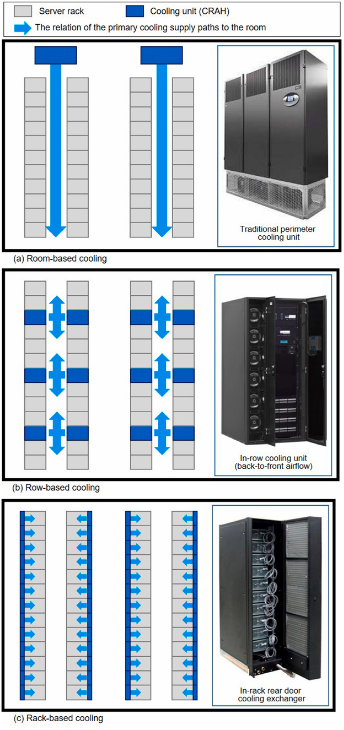
Fig. Air Cooling Technology used in Data Centers [2]
The Move Towards Liquid Cooling
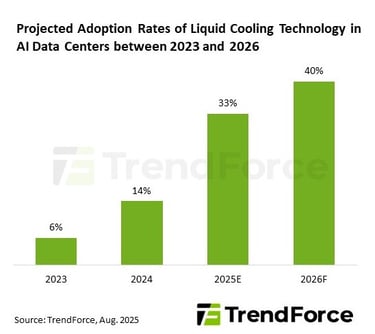
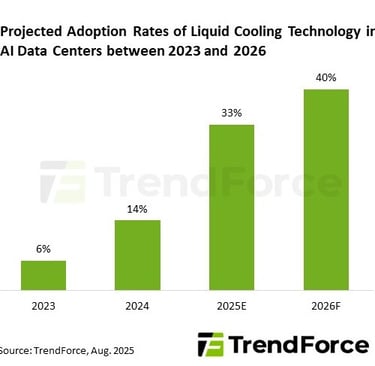
According to Danfoss, a data center cooling giant, the adoption of liquid cooling technologies in data centers was 6% in 2023, as opposed to 40% in 2026 [3]. This shows that water wasn’t the primary choice of coolant, despite having a 4x heat transfer coefficient as compared to air. Traditionally, data centers used air as the primary heat transfer medium due to mature air-cooling technologies, low rack density, minimal spatial constraints, and cheaper unit economics. The emergence of AI created a new breed of data centers catering to AI compute requirements with highly dynamic load profiles. Parallelly, advancements in semiconductor technology packed more compute into smaller chipsets, thereby increasing the rack density. The sheer volume of compute requirement meant optimizing the data center floorspace to squeeze out maximum possible IT power/sq.ft. to maintain profitable unit economics. All of this is slowly contributing to the adoption of liquid-cooling technology in modern data centers. Liquid cooling is highly efficient, can handle high heat loads, and consumes less energy than air-cooled technologies. Some of the lowest PUE (Power Usage Effectiveness = Total Data Center Power/IT Power) values, ranging from 1.1-1.2, are now possible with the adoption of liquid cooling technologies.
Liquid Cooling
1. Cold Plate Liquid Cooling: A non-contact type of liquid cooling where server chips are cooled by cold plates assembled on the electronic components with liquid as the medium of heat transfer.
Average PUE Achieved: 1.1 - 1.28
2. Immersion Liquid Cooling: A contact type of liquid cooling where server chips are immersed in the liquid medium
Average PUE Achieved:1.04 - 1.1
3. Spray Liquid Cooling: A contact type of liquid cooling where server chips are sprayed with atomized liquid particles. This arrangement uses less liquid than the other systems.
Average PUE Achieved: 1.3 - 1.4
Air-cooled systems are open loop, and they need a fresh batch of water to operate. This necessitates the need for water treatment systems to avoid scaling, microbiological fouling, and corrosion of heat transfer surfaces. Since the liquid cooled systems operate in a closed loop, no external water is required for operation. Fluid flush and fluid replacement for such systems are undertaken every 1-2 years. It is, however, false to say that all direct-to-chip cooling systems have a zero operational water footprint because hot and humid external environments necessitate CRAH/cooling towers when the outdoor air is too warm, especially in places like Texas and Arizona. For direct-to-chip cooling, a mixture of water and Ethylene Glycol is the industry standard. This mixture has a high thermal conductivity and lower viscosity, thereby minimizing cooling system failures. Immersion and spray cooling systems use dielectric coolants that are non-conductive fluids. Corrosion inhibitors are used in every closed-loop system to protect the metals from corrosion.
2. Indirect Water Consumption
Indirect water consumption refers to the usage of water for purposes other than cooling the data center. This involves the embedded water usage in construction, transportation, manufacturing of computer chips and data center hardware, and most importantly, power generation. This chunk of the data center lifecycle water usage is difficult to quantify due to the different stakeholders involved in these activities.
In a report, Xylem, an industrial and data center water supply giant, estimated that the indirect water consumption, specifically the embedded water consumption in power generation, is expected to be 48% of the total data center water consumption by 2030. It is evident that natural gas, coal, and nuclear plants consume large amounts of water to generate electricity. This case is also true for renewable sources of energy like wind and solar, where embedded water in the mining of metals and rare earths to manufacture equipment, transportation, and maintenance should be accounted for.
An analysis of the indirect water distribution from IEA reports and other sources reveals that about 80% goes towards power generation.


Table: Indirect Water Consumption Distribution by Type
As discussed before, the selection of the cooling system type can have a huge impact on the power consumption, and indirectly, water consumption. Let us do a small calculation to understand this concept.
Suppose a 100 MW AI datacenter decides to deploy an air-cooled data center with CRAH units, yielding a PUE of 1.6 (Average PUE for air-cooled + CRAH datacenters). The primary source of power is an on-site natural gas plant.
IT Power: 100 MW
Total Power Requirement: 100*PUE = 160 MW
Natural Gas Plant Water Consumption = 2800 k gallons/MWh of energy generated (EIA 2021 report)
Water Consumption Embedded in Power Generation = 160 MW*24 hrs*2800 = 10.7 million gallons/day
Direct Water Consumption = 2 million gallons/day for a 100 MW IT space facility with air cooling+CRAH (AIRSYS 2026 report)
Total Water Consumption for the Air Cooled/CRAH facility = 12.7 million gallons/day
Let us compare this to a liquid-cooled closed-loop cooling system deployment, with a PUE of 1.1 (Average PUE for liquid cooled data centers)
Total Power Requirement: 100*PUE = 110 MW
Water Consumption Embedded in Power Generation = 110 MW*24 hrs*2800 = 7.39 million gallons/day
Direct Water Consumption = 0 million gallons/day for a closed-loop liquid-cooled system with no external cooling requirements or CRAH systems
Total Water Consumption for the Air Cooled/CRAH facility = 7.39 million gallons/day
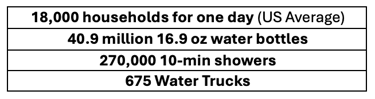
This yields us a difference of around 5.4 Million Gallons of saved water per day. This is equivalent to:
3. Consumptive vs. Non-Consumptive Water Usage
The above analysis is pointless without discussing the significance of consumptive vs. non-consumptive water usage. Consumptive water use refers to the water that is withdrawn from a basin, and not returned in usable form, whereas non consumptive water use refers to the water that is withdrawn, and is returned to the same basin often as blowdown, discharge, treated water, or warm return water. This one distinction is critical in understanding the real water usage of data centers.
Consumptive water usage in data centers is primarily a result of evaporative cooling, meaning the water is evaporated from cooling towers and adiabatic systems. Globally, 56% of the data center capacity still uses evaporative cooling; such systems have a 60% consumptive water use. Adding power generation to this conversation brings the total consumptive use down to 10-15%. This is because power generation technologies like gas, coal, and nuclear have 90-95% non-consumptive water use, with renewables having no operational water usage.
Non-consumptive water usage in the context of data centers refers to the water that is used and returned to the basin or recycled for on-site use. Water used in the cooling systems that is not evaporated is recycled and fed into the cooling loop again. After numerous cooling cycles, the concentration of minerals and salts increases due to the evaporation of some water. This water is unfit for use and is treated and sent back to lakes, rivers, ponds, and oceans. An innovative technique adopted by Microsoft in one of its data centers recycles this discarded water after it is deemed unfit for circulation, destressing local groundwater resources.
It is important to note that non-consumptive water is warmer, saltier, and chemically altered and could pose a risk to the aquatic biodiversity. The time of water withdrawal and the time of return could be widely spaced, increasing concerns about water availability during the summer months. Nevertheless, data center operators have started considering these environmental and social factors before site planning and facility design.
The image below shows the distribution of direct and indirect water consumption factors with consumptive and non-consumptive parts. On-site cooling accounts for about 25% of the total water use, with direct consumptive water usage being 12% of the total. Energy generation from non-consumptive water usage is more than 95%, as discussed before. Semiconductor and hardware manufacturing accounts for the third largest chunk of water consumption in data centers, with about 10% being consumptive. Construction and facility operation make up about 2% of the total water consumption, with approximately half of it related to consumptive water usage, primarily used in construction activities.
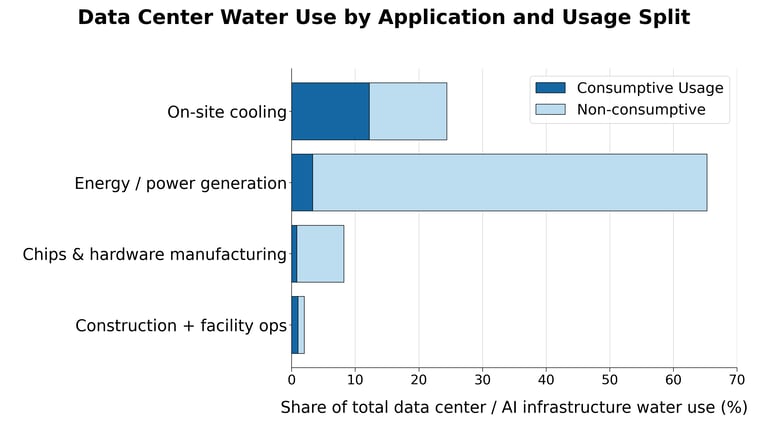
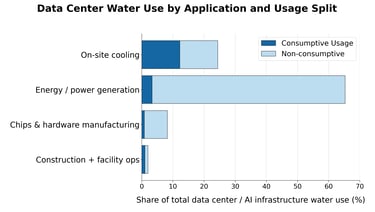
Fig. Data Center Water Use by Source and Usage Split
This brings us to the concept of WUE or Water Usage Effectiveness. WUE is the ratio of water usage per unit energy consumed by the IT server. WUE is a metric that is now being disclosed in annual data center operations reports and is a key metric of sustainability and responsible water use. The table below summarizes the WUE benchmarks of various hyperscale operators:
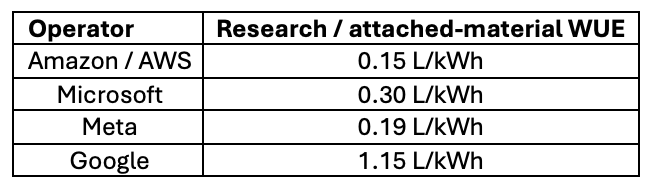
WUE mainly depends on factors such as cooling technology, climate and location, rack density, data center load characteristics, water source, and recycling. Liquid cooling technologies with a closed-loop design yield better WUE than the ones that use CRAH units. Climate plays an important role in the type of cooling system used, as hotter areas almost always need cooling towers and CRAH units. Colder places offer numerous advantages where direct air cooling, using cold air from the atmosphere to cool the data centers, which reduces water dependency. Data centers in proximity to cooler water bodies can entirely bypass water chiller units.
Recently, some WUE metrics also include power generation metrics. This can change WUE benchmark calculation entirely. For example, a data center in Canada will have a high WUE than an identical data center based in West Virginia due to Canada’s high percentage of hydropower in the energy mix. A lower WUE with power generation embedded in the calculation, does not necessarily mean efficient water utilization.
It should also be noted that the calculation of WUE is not standard and could sometimes consider only consumptive use or total water withdrawal. Microsoft, for example considers the total water consumed for humidification and cooling while reporting WUE metrics.
Comparison of Water Footprint of Data Centers with Adjacent Industries:
Data centers industry is growing at an unprecedent rate and so are other adjacent industries like Power Generation and Semiconductors. It is thus, beneficial to compare the water footprints of these industries. The image below shows the water withdrawal of these industries. It is apparent that the power generation industry has the largest water withdrawal footprint of the three, with almost 18 trillion liters in 2026, poised to grow by 18% by 2050. This is mainly because of the phasing out of coal plants and adoption of renewable energy sources and natural gas, that have a high water usage efficiency. Comparatively, the semiconductor industry water withdrawal stands at 5 trillion as of 2026, and will grow by 613% by 2050. This industry requires very high quality water, also called as ultrapure water, making recirculation and reuse of used water difficult. The data center industry is dwarfed by these giants and is poised to grow by 272% by 2050. The total water consumption of these industries combined in 2050 is estimated to be 60.5 trillion liters.
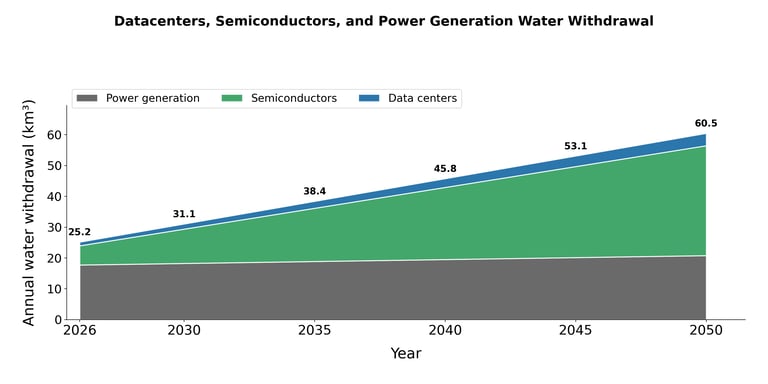
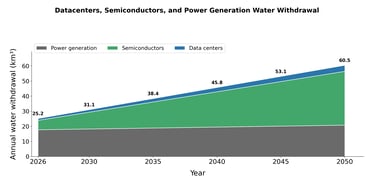
Fig. Data Centers, Semiconductors, and Power Generation Water Withdrawal
In comparison, the data center industry is only a fraction of the total water withdrawal of the combined. Semiconductor industry, on the other hand, is the real hidden water guzzler. Moreover, most of the semiconductor fabs will be built in water scarce regions. This is the same case with data centers. We will discuss this issue in the next article and suggest strategies to address them.
References
1. https://amp.xylem.com/m/aa10f8022757c5e/original/Watering-the-New-Economy-DIGITAL-final.pdf
2. Gou Zhonghua, Senhong Cai, “Towards energy-efficient data centers: A comprehensive review of passive and active cooling strategies,” Energy and Built Environment,2026, Vol. 7, pg. 206-226.
3. https://www.trendforce.com/presscenter/news/20250821-12682.html
4. https://airsysnorthamerica.com/how-much-water-does-a-data-center-use/
5. https://www.publicpower.org/periodical/article/how-much-water-our-electricity-uses
6. https://www.eia.gov/todayinenergy/detail.php?id=56820
7. Alexandre d'Orgeval, Stuart Sheehan, Quentin Avenas, Edi Assoumou, Valentina Sessa, “Generative AI impact assessment through a life cycle analysis of multiple data center typologies,” Applied Energy, Volume 406, 2026, 127288, ISSN 0306-2619
8. De Vries-Gao, “A The carbon and water footprints of data centers and what this could mean for artificial intelligence,” Patterns, 2025; 7
Connect
info@energizetomorrowus.com
© 2026. All rights reserved.