The Birth of the Battery Passport - Ending the Era of "Mystery Minerals"
As of February 18, 2026, the EU Battery Regulation has officially moved from a roadmap to an active enforcement reality. Every industrial and EV battery with a capacity over 2 kWh now requires a Digital Battery Passport (DBP). Part 1: The Birth of the Battery Passport – Ending the Era of "Mystery Minerals"
ENERGY POLICYENERGY INDUSTRYMOST RECENT
Aadesh Aslekar
7/14/20262 min read
2026 Reckoning: No Passport, No Market
Imagine buying a car and having no idea where the engine came from, how long it will last, or if it was built using child labor. Until recently, that was the reality for the most expensive component of an EV: the battery.
As of February 2026, the European Union has closed the door on "mystery batteries." Any manufacturer, whether they are based in Berlin, Shanghai, or Detroit, must now provide a Digital Battery Passport to sell in the EU market. This is a QR-code-accessible "digital twin" that travels with the battery from the mine to the recycling plant.
What’s Under the Hood of the Passport?
A Battery Passport isn't just a serial number. In 2026, it will be a dynamic data package that includes:
Carbon Footprint: The exact amount of CO2 generated from raw material extraction to the final assembly.
The "Social License": Verified data on human rights and due diligence in the supply chain (specifically targeting cobalt and lithium mining).
State of Health (SoH): Real-time data on the battery’s remaining capacity, preventing the "lemon" effect in the used EV market.
Recycled Content: Proof of how much "old" lithium and nickel are inside the "new" battery.
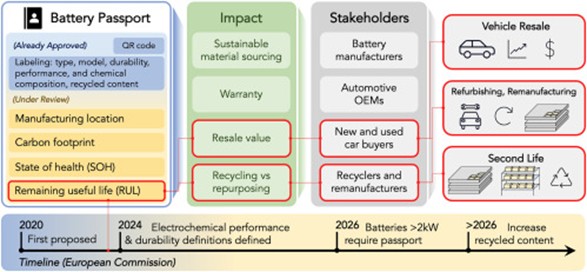
Figure 1: Overview of the digital battery passport concept, focusing on applications of the remaining useful life (RUL) metric for electric vehicle resale, recycling, and repurposing
The "Urban Mine": 2026’s New Gold Rush
The most revolutionary part of the 2026 regulation is the Recycled Content Mandate. By law, manufacturers must now prove they are using a specific percentage of recovered materials.
This has created a new industry: Urban Mining.
In 2026, we will see massive "hydro-metallurgical" plants opening across Europe and North America. These plants don't dig into the ground; they "dig" into old Teslas and iPhones. They can recover up to 95% of the lithium, cobalt, and nickel from a dead battery, feeding it right back into the production line. This "Closed Loop" is the only way to satisfy the explosive demand for EVs without destroying more of the natural world.
The Data Conflict: The Battle for Transparency
Not everyone is happy. In early 2026, we are seeing a massive "Data War" between OEMs (Original Equipment Manufacturers) and recyclers.
The OEMs want to protect their proprietary battery chemistry.
The Recyclers need to know exactly what’s inside the battery to take it apart safely and efficiently. The Battery Passport is the "peace treaty" in this war, providing tiered access to data—giving recyclers the safety info they need without handing over the secret sauce of the battery’s performance.
Conclusion: The End of the "Throwaway" Battery
The Battery Passport is the first step toward a Circular Economy. It treats a battery not as a consumable fuel tank, but as a permanent asset that stays in the economy forever.
In Part 2, we will look at the "Second Life" revolution—how AI is being used to predict which EV batteries are "retired" but still healthy enough to power our homes and the power grid.
References:
https://www.cell.com/joule/fulltext/S2542-4351(23)00136-8#fig2
https://ieeexplore.ieee.org/abstract/document/10732126
https://ieeexplore.ieee.org/abstract/document/10660637
https://onlinelibrary.wiley.com/doi/full/10.1002/bse.4346
https://axaco.s3.amazonaws.com/uploads/2021/05/17/uqYgqc6e/rev2021-048.pdf
https://erepo.uef.fi/server/api/core/bitstreams/fe31986f-98eb-4286-9f0d-54e6b0998fee/content
Connect
info@energizetomorrowus.com
© 2026. All rights reserved.