The Energy Future of Data Centers
A recent IEA report on Data Centers predits that the global data center energy consumption will more than double from 415 TWh in 2024 to 945 TWh by 2030 (equivalent to Japan’s annual electricity consumption!), and data centers will drive about 10% of global power demand by 2030! As of 2025, with the US data center vacancy rate at an all-time low of 1.6%, the markets are signaling an energy supply shortfall, even with the 84 GW of US data center pipeline expansion in 2025 alone. This astronomical growth will likely need 100s of GW of new power generation and grid upgrades, and meeting this demand will require a diverse range of energy assets. In this article, we will look at the current economics of conventional as well as renewable energy sources with the Levelized Cost of Energy (LCOE) analysis and discuss the most optimum short-, medium-, and long-term energy supply scenarios.
ENERGY INDUSTRYAI AND ENERGY
Sumedh Joshi
12/25/20259 min read
Energy has always been at the center of human evolution and has shaped the course of human history. The discovery of fire, a source of usable energy, is sometimes regarded as the most important turning point in the history of mankind. The commercialization of steam energy and coal was foundational in supporting the Industrial Revolution. The discovery and rapid commercialization of oil supported the energy needs of the 20th century, which saw the emergence of semiconductors, space exploration, and the internet. With the advent of AI, the 21st century might just be another inflection point in the history of mankind, comparable to the “discovery of modern fire.”
BloombergNEF predicts that the AI boom alone will almost double the current data center energy demand by 2030 (up from 35 GW in 2025 to 106 GW in 2030). To support this technological development based on a realistic environment of energy demand and supply, it is critical to ensure the availability and economic viability of a diverse mix of energy resources. Mainstream renewables like wind, solar, and hydropower, which make up about 22% of the US electricity generation as of 2025, have achieved economic viability that enables them to fairly compete with new fossil-based energy generation. The only places where they lose points are intermittency and high-power density needs, which are some of the key operational requirements of modern data centers. This is where natural gas, nuclear, and battery storage come into play.
Let us understand the technical and commercial aspects of these energy generation technologies.
A. Conventional Energy Generation Technologies
1. Combined Cycle Gas Turbine: CCGT uses two thermodynamic cycles – 1. Gas turbine burns natural gas to produce electricity; 2. A steam turbine runs on the residual heat of the exhaust gases that generates steam. CCGTs have become popular as natural gas prices fell, making them a go-to source of low-carbon power.
Operational Thermal Efficiency: 60%
Fuel: Natural Gas
Capacity Factor (Actual Energy Produced in a period/Maximum Possible Energy Produced in the same period): 40-60%. This is because keeping a CCGT plant running continuously increases operating costs due to higher fuel costs and makes it uneconomical.
2. Simple Gas Turbines: SGTs combine air with fuel for combustion to produce power. These were developed in WWII for aircraft propulsion. They remain vital for peaking power and back-up owing to their fast start-up times.
Operating Thermal Efficiency: 35%
Fuel: Natural Gas, Liquefied Natural Gas
Capacity Factor: 5-15%. SGTs have a lower efficiency and are only used to supply power during peak demand conditions. They are also called as gas peakers.
3. Coal Power Plants: Coal is burned in a boiler to produce steam, and in turn electricity. Modern plants have supercritical steam cycles for higher efficiency. Coal is being phased out due to high levelized costs and carbon emissions.
Operating Thermal Efficiency: 42%
Fuel: Coal
Capacity Factor: 40-70%. Coal power plants are nearing a commercial end due to higher coal prices and a growing sustainability push.
4. Nuclear Power Plants: Nuclear power plants use fission of uranium and plutonium to produce steam to generate electricity from turbines. Nuclear commercialization has faced challenges after the Chernobyl tragedy and the Fukushima accident, but it remains key for future-ready, low-carbon energy.
Operating Thermal Efficiency: 33%
Fuel: Uranium and Plutonium
Capacity Factor: 90-95%. A higher capacity factor equates to reliable and continuous baseload power. The only downtime is scheduled for maintenance and to refuel the reactors.
B. Renewable Energy Sources
1. Solar: Solar energy uses photovoltaic (PV) cells to convert sunlight into electricity. PV panels dominate the renewable energy industry due to scalability and low levelized costs. The first solar cell was built at Bell Labs in 1954.
Operating Thermal Efficiency: 22%
Fuel: Sunlight
Capacity Factor: 18-30%. This is due to the intermittent nature of the sunlight.
2. Wind: Wind turbines convert the kinetic energy of the wind into electricity. Modern turbines are very effective in supplying significant power to the grid. The levelized cost of wind has also dropped.
Operating Thermal Efficiency: 40%
Fuel: Wind
Capacity Factor: 30-45%. Wind does not continuously blow at the cut-in speed for wind turbines to be able to harness usable power.
3. Hydropower: Hydropower plants convert the kinetic energy of flowing water into electricity. Large dams provide water storage and grid stability. Hydropower is one of the earliest energy sources and is the largest and most efficient renewable source available today.
Operating Thermal Efficiency: 90%
Fuel: Flowing Water
Capacity Factor: 30-60%. Dams and hydropower plants are connected to reservoirs and cannot be operated continuously to maintain safe water levels.
4. Geothermal: Geothermal plants convert the heat trapped under the Earth’s crust to produce steam and drive turbines. Geothermal energy has low conversion efficiency, despite a high-capacity factor. The first geothermal power plant was built in Italy in 1904. With an increasing amount of funding in this technology, improvements are imminent.
Operating Thermal Efficiency: 15%
Fuel: Heat from the Earth’s Crust
Capacity Factor: 85-95%. Geothermal power has a high capacity factor due to a continuous supply of heat.
Levelized Cost of Energy (LCOE) Calculation
LCOE is a metric that represents the average cost of producing one megawatt-hour (MWh) of electricity over a power plant's entire lifetime. It aggregates all major costs: capital investment, operations and maintenance, fuel, financing, and decommissioning and amortizes them across the plant's total expected electricity generation, discounted to present value. By expressing lifetime costs on a per-unit basis, LCOE enables direct comparison across disparate technologies such as solar, wind, nuclear, coal, and natural gas.
However, LCOE reflects only production cost, not the value delivered to the grid. It excludes critical factors like reliability, dispatchability, capacity value, and system integration costs. Consequently, technologies with low-capacity factors or high system value, such as peaker plants or energy storage, may appear expensive by LCOE despite being economically indispensable for grid stability and flexibility.
The formula for LCOE is given below.


Here, CRF is the Capital Recovery Factor, expressed as:
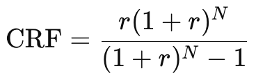
where,
r = Discount rate (WACC)
N = Plant lifetime (years)
This calculation gives us the LCOE values for the energy generation technologies under consideration. These are shown in Fig. 1.
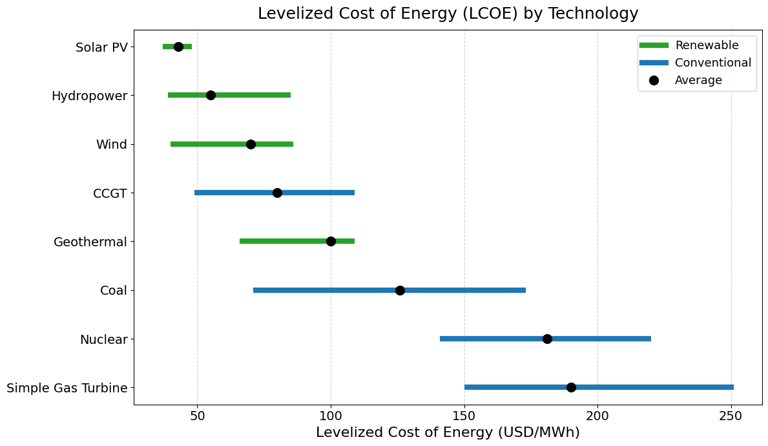
The reason solar and wind dominate the LCOE charts is due to zero fuel costs, moderate capital expenditures, the benefit of economies of scale, easy expansion, and lower maintenance costs. The only drawback that thwarts their LCOEs from dropping lower is a low capacity factor. This necessitates the use of battery storage to increase the capacity factor and provide continuous baseload power to data centers. Hydropower also has a low LCOE due to a long plant life (50-100 years). While the capital costs are very high with high construction and project failure risks, operating costs are very low, the technology is mature, and fuel costs are zero. These costs, when amortized over the useful life of the plants, render hydropower energy cheap. Geothermal power has high capital costs with the uncertainty of finding a useful energy source, much like oil drilling. Potential locations are constrained and remote, often complicating supply chains. This technology is not yet commercialized, but the future prospects look promising. With a high CF, low fuel costs, and long plant life, geothermal is attracting capital from venture capital firms and sustainability advocates. CCGTs have low capital costs, are reliable, and efficient. The operating costs are greatly influenced by gas prices that are sometimes volatile. Simple gas turbines have a lower CF, are less efficient than CCGTs, and hence are used as backup power supply units in high-demand situations. Nuclear energy is capital-intensive, with regulatory and safety concerns. Construction timelines are often very long, and commissioning can take months. Despite these drawbacks, nuclear energy is capable of providing reliable baseload power, and the fuel costs are low. Recent advancements in nuclear fusion and Small Modular Reactors (SMRs) promise the potential of realizing successful commercialization of nuclear technology for data centers. Coal, on the other hand, is in decline due to high fuel costs, old and retiring infrastructure, and rising decarbonization awareness.
Current US grid distribution is as follows:
24% solar, wind, and hydropower
40% natural gas
20% nuclear
16% coal
The reason why natural gas still dominates the energy mix, regardless of the high LCOE of CCGTs, is due to a reliable power infrastructure, a strong pipeline network, and low upfront costs. Solar and wind power have lower operating costs, but the capacity factor offsets this benefit. A lower capacity factor necessitates a larger amount of installed capacity to produce enough usable power, for ex., to have a 1 MW power output from a wind or solar plant, around 7-8 MW of rated capacity must be installed. This can be improved by technological developments in these sectors.
Some other promising technologies currently available commercially in smaller capacities are SOFC and battery storage. SOFC stands for Solid-oxide Fuel Cells and uses natural gas, hydrogen, or biogas to produce electricity. This is a carbon-neutral technology that is commercially used for multi-kW deployments. SOFC for multi-MW scale deployments is currently under development. Battery Storage on the other hand, has been around for some time and is successfully used to store grid energy in states like Texas. Using battery storage for storing energy harnessed from renewable sources eliminates the intermittency of wind and solar power, rendering them reliable baseload power providers.
Short-term Energy Supply (0-5 years) :
Given the insane amount of data center demand growth in the coming years, more focus will be on infrastructure reliability than decarbonization. CCGTs and SGTs(Gas Peakers) that use natural gas are a reliable, dispatchable, and mature source of power generation and will see growth in the next 3-5 years. The US has abundant natural gas resources, making it easier to scale. It will be ubiquitous to see on-site CCGTs soon. The low LCOE of wind and solar and the lucrative nature of PPAs (Power Purchase Agreements) will make off-site solar and wind continue to be an attractive option. Grid power will still be a big component of the power supply, but a move towards grid decentralization is necessary to avoid an increase in the utility prices for civilians living around the data center. Diesel generator backup power is also crucial to ensure that mission-critical activities are not disrupted in case of grid failure or power equipment malfunction. Battery storage is a new class of energy storage systems gaining traction due to an excellent TCO (Total Cost of Ownership).
Short Term Energy Mix:
1. Grid Power
2. CCGTs and on-site Gas Peakers
3. Off-site Wind and Solar with PPAs
4. Diesel Gensets+Battery Storage
Medium-term Energy Supply (5-10 years):
Data center demand will further increase in the 2030s. In the medium-term timeframe, CCGTs will still be around, but with a reduced utilization due to an imminent sustainability push. They will be used as backup sources rather than baseload operational units. Solar and wind will see an immense push due to ambitious sustainability goals of many hyperscalers, for ex., Microsoft and Google pledging 85-100% renewable energy use to power their data centers by 2030. An on-site solar or wind farm will be common in the medium term energy supply scenario. With the advent of commercial battery storage units, the intermittency of wind and solar will sharply disappear, increasing their capacity factors. Small Modular Reactors, or SMRs, are on-site nuclear reactors with a power capacity of less than 300 MW. This technology is still in the research and development phase, but it is estimated that SMRs will be operational on a commercial scale. This deployment will be a game changer to the data center energy supply mix. Grids will treat data centers as “anchor loads” as data centers will provide a stable revenue and demand, meaning data centers will reverse the utility cost metrics for civilians living near them, reducing utility prices. Grid dependence will fairly reduce due to a lower LCOE of nuclear SMRs and Wind+Solar+Batteries. Geothermal power will see crucial developments in the coming years, given the capital investments in the domain in the last 10 years. Hydrogen-powered Solid-Oxide Fuel Cells (SOFCs) will also emerge as strong contenders in powering data centers of the future. SOFCs use natural gas, hydrogen, and biogas, which are abundant in nature, further strengthening the case for adoption.
Medium Term Energy Mix:
1. Dedicated or On-Site Wind and Solar with Battery Storage
2. CCGTs and On-Site Gas Peakers (Backup Power)
3. Grid Power (Minimal Dependence)
4. Nuclear SMRs
5. Commercial Scale Geothermal
6. Commercial Scale SOFCs
Long Term Energy Supply (10-25) years
The concept of one data center=one power plant will be ubiquitous, partly due to enormous data center loads arising from high data and AI demand, cutting-edge semiconductor development, and advanced systems architecture, enabling multi-MW of computing power to take up the space of a Rubik’s cube (recent projections), and partly due to a push in decentralizing the grid. The equation will change from “we need more power for more compute” to “we need more compute since we have surplus power”. In the next 20 years, on-site nuclear SMRs and SOFCs might be two of the major energy generation technologies, along with a huge dedicated renewable energy supply, including solar, wind, hydro, and geothermal. The capacity factor is expected to reach up to an average of 90% for the combined renewables portfolio with the use of large-scale battery storage, driving costs down and increasing the reliability of baseload power. The grid power will act as a backup source due to a higher costs than other on-site power sources. The dependency on Natural Gas and other forms of fossil fuels will be minimal.
Long Term Energy Mix:
1. Nuclear SMRs
2. Multi-MW scale SOFCs
3. High CF Wind+Solar+Hydro+Geothermal with GW-scale battery storage
4. Grid Power (Minimal Dependence)
Conclusion
This article provides a brief overview of an ambitious energy supply scenario for the data centers of the future, based on current LCOE ranges, technology trends, market predictions, and long-term energy industry overview. These energy mix scenarios are based on realistic estimates and are in line with the sustainability goals of organizations and governments. Developments in quantum computing, earth orbiting data centers, AI and computing, and energy technologies will play an important role in shaping the carbon-neutral energy future.
Connect
info@energizetomorrowus.com
© 2026. All rights reserved.