
The Invisible Giant – Why Global Shipping is Reaching a Climate Inflection Point
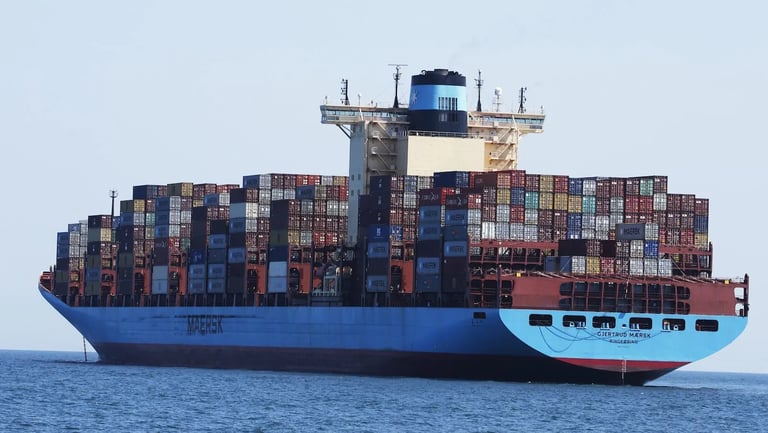
Maritime transport is the absolute lifeblood of the global economy, moving over 80% of the world’s trade by volume and 70% by value. On a per-ton basis, a massive container ship is the most carbon-efficient way to move goods, dwarfing the efficiency of air or road freight. However, "efficiency" is no longer a substitute for "sustainability." The sheer scale of the industry means that its collective footprint is staggering. If the global shipping sector were a country, it would be the sixth-largest greenhouse gas (GHG) emitter in the world, producing over one billion tons of CO2 annually. For decades, the industry operated in a regulatory "safe harbor" out of sight in international waters and was largely exempt from the early Paris Agreement targets.
ENERGY POLICY
Aadesh Aslekar
1/21/20264 min read
The Backbone of Everything
The shipping industry has been the backbone of trade since historical periods. The age of exploration, globalization, and modern trade has all hinged on this mode of transportation. Throughout the years, the shipping industry has vastly enjoyed exemptions from the Paris Agreement targets. But as we enter 2026, that period of isolation has ended. The industry is currently navigating a "perfect storm" of rising emissions, aggressive new carbon taxes, and a fundamental shift in how the world views the "Blue Economy."
The Data: A Growing Footprint in a Moving World
While sectors like automotive and energy have seen significant decarbonization over the last decade, shipping has struggled to bend the curve. Recent data shows a sobering reality: despite technical gains in vessel design, global maritime CO2 emissions rose by 9.3% between 2019 and 2024.
This increase is driven by a phenomenon known as "transport intensity." As global supply chains grow more complex, we are moving more goods, more often, and over longer distances. While a modern 24,000 TEU (Twenty-foot Equivalent Unit) container ship is far more efficient than its predecessors, the sheer volume of these "megaships" on the water is outpacing the rate of innovation. Without drastic intervention, shipping emissions are projected to grow by up to 50% by 2050.
The Hidden Enemies: Beyond CO2
To understand why the maritime industry is under such intense scrutiny, we must look beyond carbon dioxide. The industry faces a "chemical cocktail" of pollutants that affect both the global climate and the local health of coastal populations:
Sulfur and Nitrogen Oxides (SOx & NOx): Traditionally, ships burned Heavy Fuel Oil (HFO) a viscous, tar-like residue of the refining process. This fuel releases high levels of sulfur and nitrogen, which are primary causes of acid rain and chronic respiratory diseases. Despite the "IMO 2020" regulations that slashed sulfur limits, these pollutants still contribute to an estimated 265,000 premature deaths annually globally.
The Social Cost of Port Cities: Port cities are on the front lines. The air quality in major hubs like Singapore, Rotterdam, or Los Angeles is directly impacted by "hoteling" when ships keep their engines running while at berth to power onboard systems. This disproportionately affects low-income coastal communities, leading to higher rates of asthma and cardiovascular failure.
Black Carbon (Soot): This is the "short-lived" but deadly climate force. When ships travel through Arctic routes, soot settles on the white ice. This darkens the surface, causing it to absorb more heat instead of reflecting it. This "albedo effect" accelerates the melting of the polar ice caps, a tipping point that impacts the entire global climate system.
The Methane Slip: As companies transition to Liquefied Natural Gas (LNG) as a "bridge fuel," they face the risk of "methane slip” unburnt methane escaping from the engine. Since methane is 80 times more potent than CO2 over a 20-year period, even a 1-2% leak can completely negate the environmental benefits of moving away from oil.
2026: The Year the "Stick" Hits
For years, maritime decarbonization was a matter of voluntary "corporate social responsibility." That changed on January 1, 2026. We have moved from the era of aspirational targets to the era of mandatory financial liability.
The EU ETS (Emissions Trading System) 100% Phase-In: As of this year, the shipping industry is fully integrated into Europe’s carbon market. After a multi-year phase-in, shipping companies must now purchase "EU Allowances" for 100% of their reported emissions for voyages between EU ports. This is a massive financial shift; an average bulk vessel could see its annual operating costs increased by over €1.3 million purely in carbon taxes.
Fuel EU Maritime & The Rise of CO2e: 2026 marks the first full reporting cycle for the Fuel EU Maritime regulation. Crucially, this law doesn't just look at CO2; it looks at CO2 equivalent (CO2), meaning companies are now being taxed for their methane and nitrous oxide emissions as well.
The IMO 2023 Strategy Milestones: The International Maritime Organization (IMO) has set a "Net-Zero by or around 2050" target. But the real pressure lies in the 2030 checkpoint: a mandate to reduce total annual GHG emissions by at least 20% (striving for 30%) compared to 2008 levels. With 2030 just four years away, the typical 25-year lifespan of a cargo ship means that any vessel ordered today must be ready for a zero-carbon future.
The Economic "Price Gap"
The biggest roadblock to a sustainable fleet isn't a lack of imagination; it's the "Green Premium." Today, carbon-neutral fuels like green ammonia or e-methanol are three to four times more expensive than conventional heavy fuel oil. For an industry that operates on razor-thin margins and carries the world's low-cost consumer goods, this price gap is a chasm.
However, the introduction of carbon pricing is designed to bridge this gap. By making it more expensive to burn fossil fuels, regulators are attempting to make green fuel competitive. The goal is simple but brutal: make it more expensive to pollute than it is to innovate.
Conclusion: No Safer Harbor
The regulations of 2026 have removed the "safe harbor" of inaction. For shipowners, charterers, and the global brands that rely on them, the question is no longer whether they should decarbonize, but how they can do it without facing losses.
References:
https://www.researchgate.net/publication/375470466_A_review_on_carbon_emissions_of_global_shipping
https://essd.copernicus.org/articles/17/277/2025/
https://wwwcdn.imo.org/localresources/en/OurWork/Environment/Documents/First%20IMO%20GHG%20study.pdf
https://link.springer.com/article/10.1007/s44312-023-00001-2
https://link.springer.com/article/10.1057/s41278-024-00310-3?fromPaywallRec=false
Connect
info@energizetomorrowus.com
© 2026. All rights reserved.