
Why Green Shipping Corridors are the Highlight of 2026
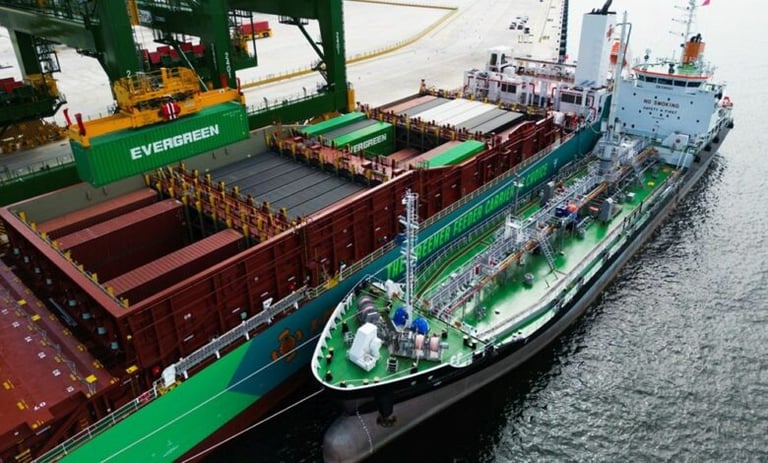
For years, the maritime energy transition was paralyzed by a classic paradox. Shipowners were hesitant to invest billions in ammonia or methanol-powered vessels without a guaranteed global refueling network. Conversely, energy producers refused to build multi-billion-dollar green fuel plants without a guaranteed fleet of ships to buy the output. In 2026, the industry found its answer: Green Shipping Corridors. Instead of trying to turn the entire ocean "green" at once, the industry is concentrating its efforts on specific, high-volume trade routes. Aligning ports, shipowners, and energy providers on a single route creates a "predictable ecosystem" where zero-emission shipping is not just a pilot project.
MOST RECENTENERGY INDUSTRYSUSTAINABLE TECHNOLOGIESENERGY POLICY
Aadesh Aslekar
3/8/20263 min read
2026 Milestone: From Feasibility to Realization
As of March 2026, the number of active Green Corridor initiatives has surged to 84 worldwide. More importantly, the nature of these projects has fundamentally changed. While 2024 and 2025 were years of "feasibility studies" and Memorandums of Understanding (MoUs), 2026 is the year of The Realization Stage.
Four major corridors, including the Stockholm-Turku and Australia-East Asia Iron Ore routes, have officially moved into operation or active construction of fuel infrastructure. These corridors are no longer just environmental experiments; they are the new "Silk Roads" of a decarbonized global economy.
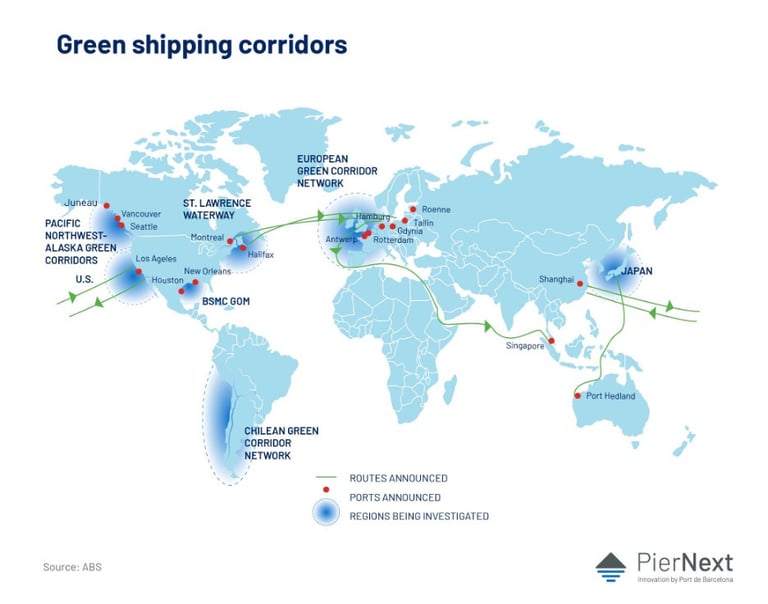
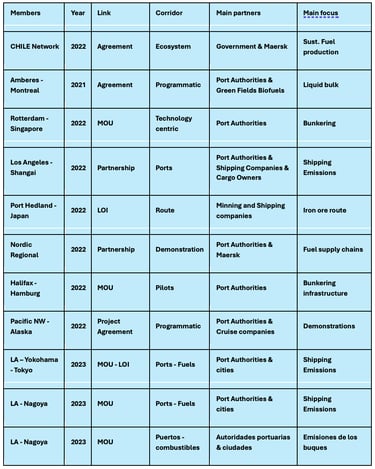
GSC announced around the world and its main characteristics
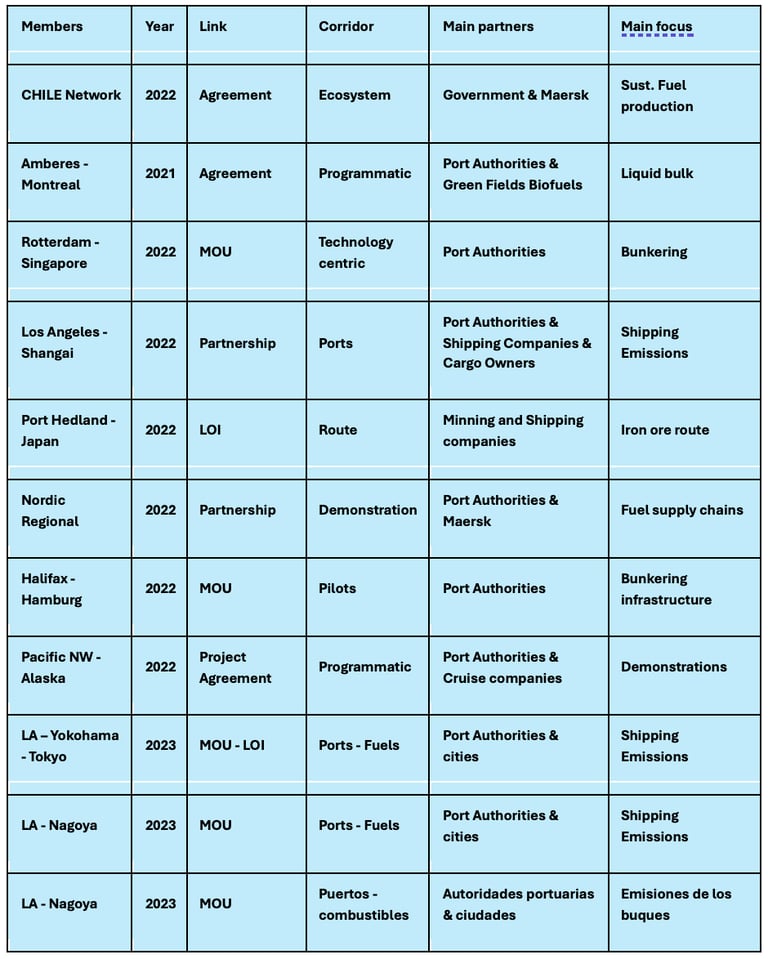
The Trans-Pacific Powerhouse: Shanghai to Los Angeles/Long Beach
The world’s most critical trade lane is currently providing the blueprint for large-scale decarbonization. By early 2026, the Shanghai-LA corridor has achieved 100% shore-power electrification across all three participating ports. This means container ships no longer need to burn fuel while docked, instantly slashing the local health impact of port emissions.
Furthermore, the Port of Shanghai has successfully bunkered over 47,000 tonnes of green methanol, marking a historic linkage between domestic Chinese production and international shipping demand. This isn't just a technical win; it’s proof of concept that the world's largest trade partners can align with fuel standards despite geopolitical tensions.
The Global Reach: New Entrants in 2026
While the "First Wave" of corridors was led by Europe and the U.S., 2026 has seen a massive expansion into the Global South.
India: A new platform was launched in early 2026 to accelerate India’s maritime transition, focusing on the potential for green hydrogen hubs in the Indo-Pacific.
Brazil & Namibia: Both nations are positioning themselves as "E-Fuel Superpowers," using their vast solar and wind resources to produce green ammonia for export to European and Asian corridors.
The Baltic Sea: The Port of Klaipeda is set to begin domestic green hydrogen production this year, providing a critical refueling node for the increasingly regulated European waters.
Closing the Cost Gap: The 2026 Financial Strategy
The elephant in the room remains the cost. Even with technological advances, the total cost of ownership for a zero-emission vessel can be hundreds of millions of dollars higher than its fossil-fuel counterpart over its 25-year lifespan.
To combat this, 2026 has seen the rise of "Book and Claim" systems. This allows cargo owners (like IKEA or Amazon) to pay a premium for green transport on a specific corridor, even if their specific box is on a different ship. This system enables carbon setting, allowing companies to reduce emissions within their own supply chain, rather than offsetting them elsewhere. This "de-couples" the physical fuel from the green credit, allowing companies to pool their demand and provide the long-term price certainty that banks need to fund these projects.
Initiatives: Projects by the Mærsk McKinney Møller Center for Zero Carbon Shipping (MMMCZCS), RMI, Danish Shipping, and Mærsk Oil Trading are actively developing such maritime systems
The Road to 2030
The goal of these 84 corridors is not to remain isolated bubbles of sustainability. They are "Living Labs" meant to generate the data, safety standards, and operational experience needed for the entire 50,000-ship global fleet.
As we look toward the IMO's 2030 checkpoints, the success of these corridors will determine whether the industry meets its targets or falls into a "climate lag." For the first time, we aren't just hoping for a green future; we are mapping the specific routes that will take us there.
References:
https://www.zerocarbonshipping.com/green-corridors
https://globalmaritimeforum.org/green-corridors/
https://piernext.portdebarcelona.cat/en/environment/green-shipping-corridors/
Press Release:Press Information Bureau
North-East Brazil green energy parks and green shipping corridors - International Partnerships
“Book” the fuel and “claim” the benefits – a fundamental enabler for scaling up SAF deployment
Avoiding Emissions in Shipping with the Book and Claim Approach - Hapag-Lloyd
Connect
info@energizetomorrowus.com
© 2026. All rights reserved.